Monday, May 31, 2010

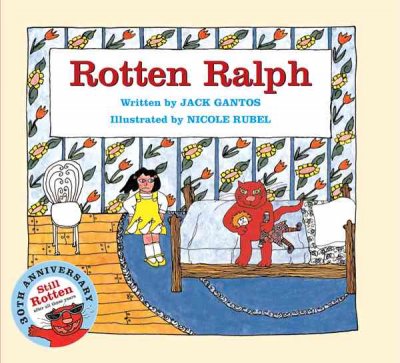
Book 6: Rotten Ralph


Standards:

K-4.1 Identify qualities of good citizenship, including honesty, courage, determination, individual responsibility, and patriotism.

K-4.2 Demonstrate good citizenship in classroom behaviors, including taking personal responsibility, cooperating and respecting others, taking turns and sharing, and working with others to solve problems.

Summary:

Rotten Ralph is a story of a very rotten cat named Ralph. Ralph has no self-control and does whatever he wants. He pulls the heads off of his little girls dolls, makes fun of her when she dances, saws off the branch when she is swinging, ruined Sarah’s party by taking a bite out of every single cookie. Ralph did a lot of rotten things. One day Ralph went to the circus with his family, but he was more rotten than ever there and his family left him behind to be in the circus because his behavior was so bad. Ralph had to work so that he could be fed and he did not like it. Finally one day he escaped but he was so sad and lonely. Ralph was sitting on a trashcan at the park when Sarah found him. She took him back home and Ralph promised to never be rotten again.

Objectives:

The children will demonstrate an understanding of being a good citizen by providing an example of something that does not show self-control in society.


Materials:

Book: Rotten Ralph by Jack Gantos

Chart paper

markers

Procedure:

1. The teacher will read the book Rotten Ralph to the class while constantly pointing out all of the bad things that Ralph does that he should not do.
2. The teacher will talk to the students about how it is not acceptable to behave as Ralph did in the story because it is our job to be good citizens and have self-control which means not doing something that may be considered not appropriate or following the rules.
3. The teacher will talk to the students about why it is important to have self-control in a community and things that they do that show self control.
4. The teacher will ask the students to describe some behaviors that do NOT show self-control and she will write them on the chart paper.
5. As she writes each one she will discuss with the students why that behavior is not acceptable and does not demonstrate self-control and talk about the opposite behavior of the one suggested that would show self-control.
6. The teacher will conclude the lesson by going over what it means to have self-control and remind the children how important it is to have this at home, at school, and in their communities.

Book 5: The Rainbow Fish


Standards:

K-4.1 Identify qualities of good citizenship, including honesty, courage, determination, individual responsibility, and patriotism.

K-4.2 Demonstrate good citizenship in classroom behaviors, including taking personal responsibility, cooperating and respecting others, taking turns and sharing, and working with others to solve problems.

Summary:

The Rainbow Fish is a story of the most beautiful fish in the world, because he had sparkling scales of blue and green and purple. All of the other fish in the sea were amazed at rainbow fish’s beauty. One day a little fish asked Rainbow Fish if he could have one of his shiny scales but rainbow fish did not want to give up his shining scales, he loved them! After that, no one wanted to play with Rainbow Fish or admire his scales and he became lonely. He realized that his beautiful scales were no good when there was no one to admire them. Rainbow Fish goes to the octopus for advice and he tells Rainbow Fish that he must give his scales away and that he may no longer be the most beautiful fish, but he will be happy. Rainbow fish began to give his scales all away and he was so delighted and his friends were thrilled. Rainbow Fish was so happy with his decision to give away something that he loved the most to make someone else happy, and he swam away with his friends.

Objectives:

The students will demonstrate what it means to be a good citizen by drawing a picture that represents a time when they were a good citizen and helped someone in their family, classroom, or community.

Materials:

Book: The Rainbow Fish by Marcus Pfister

White computer paper

Markers

Crayons

Procedure:

1. The teacher will read the book The Rainbow Fish to the class.
2. The teacher will periodically stop during the read to point out the times when the Rainbow Fish is a good citizen and made contributions to his community by giving them his shiny scales.
3. The teacher will talk to the students about why it is important to sometimes be selfless like the rainbow fish as he thought of others and their happiness and not just his own.
4. The teacher will also point out to the students that The Rainbow Fish was happier when he shared his gift with the other fish in his community and how sharing and giving are very important parts to a community.
5. The teacher will talk to the students about times when they might have shared or made a contribution to another person by sharing a gift that they may have to the community or to another student.
6. The teacher will ask the students to each take a sheet of paper and draw a picture of themselves when they have done something for someone else, or shared a gift with someone else even though they may not have wanted to (such as with a sibling).
7. The teacher will ask the children to come to circle once they have finished the drawings and explain what the picture means to the class and how it demonstrates them being a good citizen of their family, classroom, or community.

Book 4: Make Way For Ducklings


Standards:

K-2.3 Identify people in the community and school who enforce the rules that keep people safe, including crossing guards, firefighters, and police officers.

Summary:

Make Way For Ducklings is a book about a duck couple in search of a home to have their babies. They try several different places but none of them seem to be right to raise a family. Once place had no food, the other had wild animals, and one was just too dangerous because of all of the human traffic. Finally they find the perfect place and they make friends with a policeman named Michael who feeds them peanuts every day. Mrs. Mallard lays her eggs and they quickly hatch into eight ducklings. Mrs. Mallard taught the ducklings how to swim and find food and finally she taught them how to walk. One day they waddled until they came to a highway but there were too many cars and the Mrs. Mallard and her ducklings were in trouble. None of the cars were stopping for them and then Michael the policeman came to the rescue! He blew his whistle and stopped traffic so that Mrs. Mallard and her eight ducklings could cross the highway. He called in for reinforcements and four more policemen came and stopped traffic completely so the ducks could walk straight into the public garden where Mr. Mallard was waiting for them. The ducklings thanked the policemen and were happy to be in their new home.

Objectives:

The students will come up with a list of class rules and have an officer of the week who will be expected to enforce these rules.

Materials:

Book: Make Way For Ducklings by Robert McCloskey

Poster Board

Marker

Police badge

Procedure:
1. The teacher will read the book Make Way For Ducklings to the class.
2. During the read, the teacher will point out that the police officers stopped traffic so that the ducks could cross the road to the pond without being harmed.
3. The teacher will talk to the students about what police officers do and how they are important to the community because they enforce the rules and protect people in the community (and animals too!).
4. The teacher will talk about the importance of rules and having people to enforce the rules because it is a way that we are protected.
5. Together as a class, the teacher and the students will make a list of their own classroom rules for their classroom community.
6. The rules will be decided on together and the class must abide by the rules that the students have come up with.
7. Once the rules have been placed and agreed upon in the classroom there will be a police person of the week that will enforce those rules in the classroom by nicely reminding a student when he or she has broken one of the rules.
8. Each week the police person will change so that each student will have an understanding of what it feels like to be a rule enforcer in their classroom community.

Book 3: It's Mine!


Standards:

K-4.1 Identify qualities of good citizenship, including honesty, courage, determination, individual responsibility, and patriotism.

K-4.2 Demonstrate good citizenship in classroom behaviors, including taking personal responsibility, cooperating and respecting others, taking turns and sharing, and working with others to solve problems.

Summary:

The book It’s Mine! is a story of three frogs, Milton, Rupert, and Lydia who all live on an island. These frogs have a hard time getting along and they quarrel and quibble all day long. They fight over whose island it is that they live on, who gets the worm, and even who’s world it is they are in. One day a large toad comes over to talk to the three little frogs. He explains to them that he can hear them arguing all the way from his island and told them that they can’t go on like that. Then a great storm comes and the frogs are scared and sad. They only have each other and eventually only have one rock to share to keep them alive. Finally the storm subsides and the rock that saved them all is no rock at all, it is the large toad. From then on the frogs shared everything and appreciated each other and referred to everything on the island as theirs.

Objectives:

The students will demonstrate with their actions in the classroom of what a compassionate citizen does, in which the teacher will recognize and then reward with a stickers.

Materials:

Book It’s Mine!, by Leo Lionni

Compassion Chart

Stickers

Prize box

Compassionate Citizen Awards


Procedure:

1. The teacher will read the book It’s Mine! to the students.
2. Periodically, the teacher will stop during the book and point out times when the frogs do not share and when they do not show compassion towards the other frogs and their feelings.
3. The teacher will talk to the children about the word compassion and what it means.
4. The teacher will explain to the students that compassion is an emotion that shows caring for people and other things, not just yourself.
5. The teacher will talk to the students about why it is important to be compassionate and about how being compassionate is a large part of being a good citizen of a community or a classroom.
6. The teacher will explain to the students that there is going to be something new on their wall in the classroom.
7. The teacher will hold up the “compassion chart” to the class and will explain to the students that they will get a sticker on the chart each time the teacher sees him or her do something that shows they are being compassionate towards another student in the classroom.
8. The teacher will give some examples of what would be considered being a compassionate citizen of the classroom such as helping another student with a question they might have, letting a student get in front of you in the line, helping someone out when they are in need.
9. Once a student has received three stickers on the chart, they will be allowed to choose a prize from the prize box and they will also receive an award for being a good compassionate citizen of the classroom.
10. The teacher will explain to the students that she hopes that they will all work hard to help each other and respect and care for each other in the classroom so that their classroom will be a more compassionate place.

Book 2: Shhh!


Standards:

K-4.1 Identify qualities of good citizenship, including honesty, courage, determination, individual responsibility, and patriotism.

K-4.2 Demonstrate good citizenship in classroom behaviors, including taking personal responsibility, cooperating and respecting others, taking turns and sharing, and working with others to solve problems.

Summary:

This is a story about a shrew, who wanted to tell the whole world something, but it was too noisy for him to be able to. Everyone in the town is so noisy that when the shrew even tries to tell his news, no one can hear him. He tried to shout it from the valley and on the mountaintop, but the world was just too noisy. Then finally, everyone counts to three and there is silence. Everyone in the world sat still and listened to what the shrew had to say. Finally the shrew was able to tell his secret that if everyone sat and listened, there would be peace on earth.

Objectives:

The students will demonstrate what it means to be a good citizen by taking turns talking in groups.

Materials:

Book: Shhh! By Jeanne Willis and Tony Ross

Toilet paper rolls

Paint

Glue

Streamers

Glitter

Procedure:
1. The teacher will begin by reading the book Shhh! To the students.
2. Once the teacher has read the book she will talk to the children about what happened in the book and why the shrew had such a hard time getting anyone to listen.
3. The teacher will talk to the students about what it means to be a part of a community and how that includes being a good citizen.
4. The teacher will talk to the students about how being a good citizen is respecting others and their ideas and listening to what they have to say.
5. The teacher will pass out the paper towel rolls, streamers, paint, and glitter.
6. The teacher will have the students as a group work together to decorate the paper towel roll to be used as a talking stick within their groups.
7. The teacher will explain to the students that they will use these taking sticks as practice in their groups and that if someone has something to say within the group they must hold the talking stick while speaking and that they other students should respect their classmate and listen while he or she is speaking while holding the stick.
8. The teacher will remind the students that they are to take turns holding the talking stick so that everyone has a chance to speak and be heard because that it what good citizens do, they respect others words and ideas by listening to them.

Book 1: Somebody Loves You, Mr. Hatch


Standards:

K-4.1 Identify qualities of good citizenship, including honesty, courage, determination, individual responsibility, and patriotism.

K-4.2 Demonstrate good citizenship in classroom behaviors, including taking personal responsibility, cooperating and respecting others, taking turns and sharing, and working with others to solve problems.

Summary:

Somebody Loves You, Mr. Hatch is a story about a man named Mr. Hatch that lives a lonely, routine life. One Valentines Day he gets a package at his door with a heart box of candy and a note that says: “somebody loves you.” Mr. Hatch is so thrilled that someone has thought of him that he goes out into the community and starts to help others. He watches the newsstand man’s stand for him so he could go to the doctor, he found the grocer’s little girl for him, and he baked brownies for the children in the neighborhood. Then one day the postman comes to Mr. Hatch’s door and tells him that the package was not for him and he is so sad and he goes back to his lonely, routine life. Then one day there is a knock at his door. It is the entire neighborhood with heart boxes of candy and a big banner that says: “everybody loves Mr. Hatch.”

Objectives:

The students will recognize what it means to be a good citizen in a community by placing the name of a fellow student into the “good citizen jar” and explaining what it was that he or she did that made them a good citizen.

Materials:

Book Somebody Loves you, Mr. Hatch by Eileen Spineli

Glass jar

Slips of paper

Pencils

Smartboard

Procedure:

1. The teacher will read the book Somebody Loves You, Mr. Hatch to the class.
2. During the book read, the teacher will point out all of the things that Mr. Hatch does that are considered to be qualities of a good citizen such as helping others and being responsible and trustworthy.
3. The teacher will talk to the students about what being a good citizen means and will write the words that the students use to describe a good citizen on the smartboard.
4. The teacher will talk to the students more about how the qualities discussed make a good citizen and why it is important to be a good citizen to help others in any way that you can.
5. The teacher will show the glass jar to the students and explain to them that it is going to be a new part of their writing center.
6. The teacher will tell the students that the jar is going to be called the “good citizen jar” and that it is for them to nominate each other for something that they might have done that considers for them to be a good citizen of the classroom.
7. The teacher will explain to the students that they are to write the student’s name on the slip of paper that they are nominating and then must write a few words about what he or she did to become nominated.
8. The teacher will explain to the students that they are to nominate other students when they have seen them do something that represents what a good citizen should do and that they are not to nominate themselves.
9. The jar will be at the writing center and at the end of the month; the teacher will draw a name from the jar for a student to win a good citizen prize.